AI Search and SEO for Restaurants and Retail
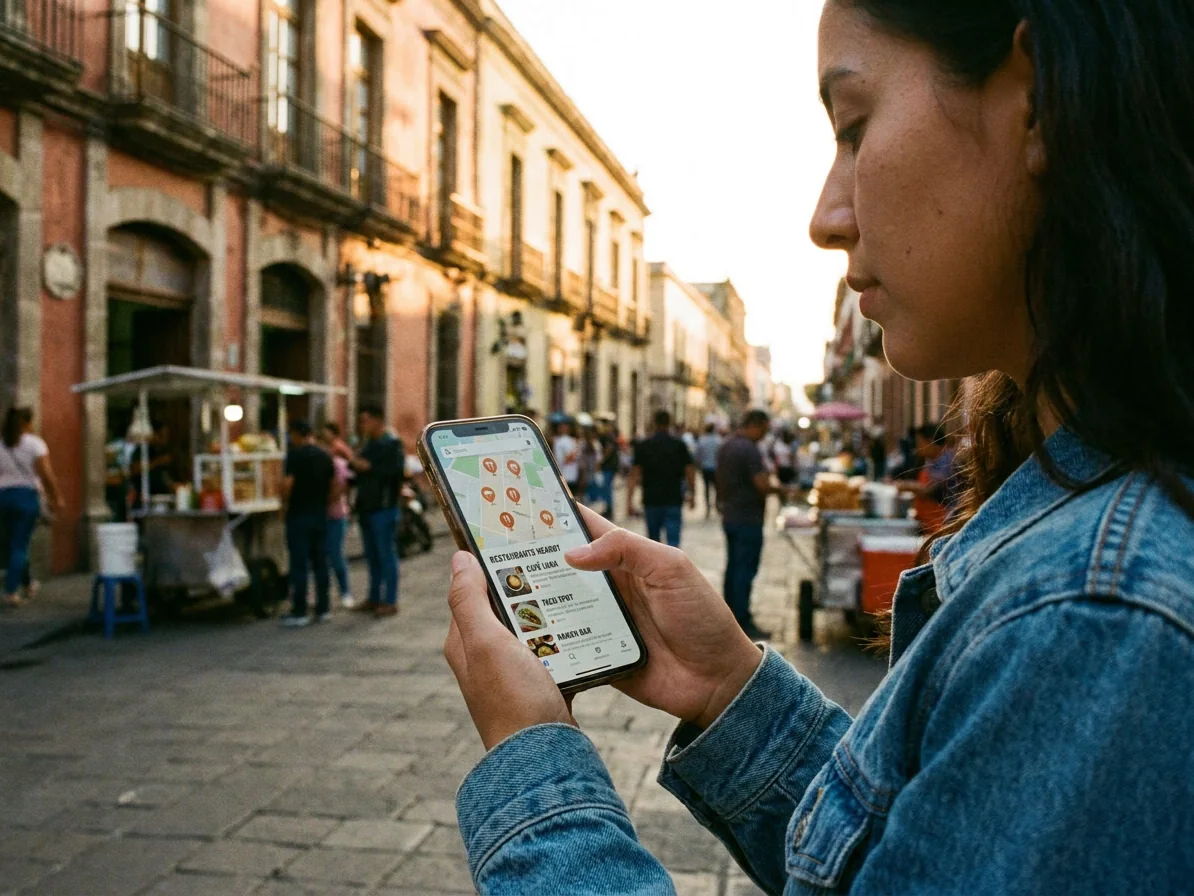
For restaurants and local retail, most decisions happen on a phone within a few blocks. Here is how to be the answer when someone searches, asks a map, or asks an AI where to go.
 Industry Guide
The gist
- A hungry person on a sidewalk is not browsing.
- For a local restaurant or shop, the Google Business Profile and the map pack often matter more than the website itself.
- A menu buried in a PDF or a photo is invisible to search engines and AI.
- In food and retail, freshness of reviews matters as much as the total.
Near me is the whole game
A hungry person on a sidewalk is not browsing. They are deciding. They search best tacos near me, or sushi open now, or gift shop near me open late, and they act on the top result within minutes. The distance between showing up first and showing up fourth is the distance between a full table and an empty one.
These searches are hyper-specific and increasingly conversational. People search by dish, by dietary need, by occasion, and by moment. best patio for brunch, gluten free bakery near me, where to buy a last minute birthday gift. Each phrase is a customer telling you exactly what they want, and the business whose online presence answers that phrase wins the visit.
- Dish and product level searches, not just cuisine or category
- Open now and hours-driven intent that changes by the minute
- Dietary and occasion filters like vegan, gluten free, date night, group friendly
- Directions and map pack taps that turn straight into foot traffic
Your Google Business Profile is your real homepage
For a local restaurant or shop, the Google Business Profile and the map pack often matter more than the website itself. It is where hours, photos, menu, reviews, and the directions button all live, and it is what shows up first when someone searches nearby. A neglected profile is lost revenue, plain and simple.
Keeping it accurate and complete is not a one-time task. Hours change for holidays, menus change with seasons, and photos go stale. Getting this right, week after week, is a big part of how we help restaurants and retail capture the customers who are already looking for them.
Wrong holiday hours are the most expensive small mistake in local. A customer who drives to a closed door does not just leave. They often leave a one-star review on the way out.
Menus and hours as structured data
A menu buried in a PDF or a photo is invisible to search engines and AI. When your menu, prices, hours, and location are marked up with schema.org structured data, Google and the AI engines can read them directly, which means your dishes can surface for those specific dish-level searches and your hours can answer open now queries automatically.
The same is true for retail inventory and categories. Structured data turns your site from a pretty brochure into a machine-readable source that engines trust and quote. This is the difference between hoping to be found and being built to be found.
- Menu items and prices marked up so dishes appear in relevant searches
- Hours and holiday hours in structured form so open now works
- Location and service-area data that feeds the map pack
- Product and category markup for retail so items surface individually
Review velocity, not just review count
In food and retail, freshness of reviews matters as much as the total. A steady stream of recent reviews signals to both customers and search engines that you are busy, current, and worth choosing right now. A great rating from two years ago with nothing since reads as a place that might have closed.
The move is to make asking for reviews a natural part of service, not an afterthought. A simple, consistent prompt at the right moment turns happy guests into a constant flow of recent feedback. In our client work, restaurants that build review velocity into the shift routine climb the map pack noticeably faster than those who ask once in a while.
Being the spot AI recommends
People now ask ChatGPT, Perplexity, and Copilot for dinner ideas and shopping suggestions the way they used to ask a friend. Where should I take my parents for a nice dinner. Best independent bookstore around here. Google's AI Overviews do the same thing inline. The businesses these engines name are the ones with clean structured data, strong recent reviews, and clear signals about what they are known for.
You cannot pay your way into an AI recommendation. You earn it by being unambiguously the best answer to a specific need, and by being readable to the machines. Add an llms.txt file, keep your structured data current, and make sure your signature dishes or products are described in plain language people actually use.
Ask an AI engine for the best version of your signature dish in your area. If a competitor comes up and you do not, that gap is fixable, and it is worth fixing this quarter.
Pairing organic reach with paid where it counts
Search and the map pack bring in the people already looking for you. But new location launches, slow seasons, and big promotions sometimes need a push to the people who do not know you yet. That is where a coordinated advertising layer earns its keep, filling seats on a Tuesday or moving seasonal inventory before it ages out.
The strongest local operators run both together, using omni-channel advertising to amplify the moments that matter while organic search carries the everyday demand. One system, working the whole funnel, instead of two disconnected efforts.
Frequently asked
What matters more for a restaurant, the website or the Google Business Profile?
Both matter, but for day-to-day foot traffic the Google Business Profile and map pack usually drive more decisions. Keep hours, menu, photos, and reviews current there, and use the website to reinforce it with structured data and deeper content.
How do I show up for best dish near me searches?
Mark up your menu with schema.org structured data so individual dishes are readable by search engines and AI, describe them in the words customers actually use, and keep strong recent reviews. Dish-level visibility comes from being machine-readable, not from a menu locked in a PDF.
How many reviews do I need?
There is no magic number. What matters is a steady flow of recent reviews rather than a big total that has gone stale. Build the ask into your normal service so fresh feedback keeps arriving, which signals to engines and customers that you are busy right now.
Can I get my restaurant recommended by ChatGPT or Perplexity?
You can earn it, though not buy it. Keep clean structured data, an llms.txt file, strong recent reviews, and clear descriptions of what you are known for. Engines recommend the businesses they can read clearly and verify as the best answer to a specific request.
Want this handled for you?
We build and run exactly what this article describes. Start with a free, plain-English audit of where your search and AI visibility stands.
Get your free audit →